Enferra
Extreme-Environment Control Electronics
Electronics are often the limiting factor in systems operating under extreme heat.
Enferra focuses on integrated circuits designed to perform sensing, signal processing, and deterministic control where conventional electronics cannot survive.
The problem is at the point of operation.
Conventional silicon electronics typically require junction temperatures below approximately 150 °C for reliable operation. When systems operate beyond this threshold, engineers must redesign architectures to protect electronics from the environment.
Common mitigation approaches increase system complexity and introduce additional failure modes. Enferra focuses on electronics that remain embedded directly inside high-temperature environments.
Eliminate relocation trade-offs
Moving electronics away from heat sources requires long wiring harnesses and increases latency between sensing and control. Embedded electronics close that gap.
Reduce cooling overhead
Introducing cooling systems adds weight, complexity, and potential failure modes. High-temperature electronics operate without the need for active thermal management.
Control at the point of operation
The objective is to maintain control logic at the point of operation rather than relocating it away from the system, enabling more direct and responsive control.
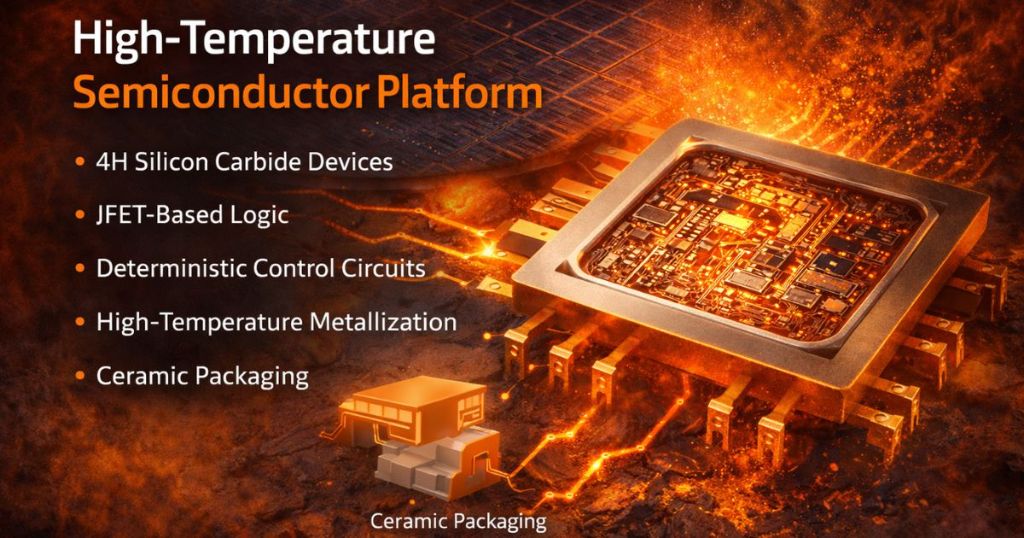
High-Temperature Semiconductor Platform
Enferra electronics are based on semiconductor architectures designed for operation in extreme thermal environments. The platform integrates sensing interfaces, mixed-signal processing, and deterministic control circuits on a single high-temperature device.
Silicon Carbide Devices
Circuits are implemented on 4H silicon carbide, a semiconductor material capable of maintaining electrical stability at temperatures far above those tolerated by conventional silicon.
JFET-Based Logic
The architecture uses junction field-effect transistors rather than oxide-gated MOS devices. This approach reduces gate oxide failure mechanisms that occur under sustained high temperatures.
Deterministic Control Circuits
The electronics perform fixed sensing and control functions rather than general-purpose computing. Circuits execute threshold monitoring, signal conditioning, and control logic directly within the device.
High-Temperature Metallization
Specialized metallization layers maintain stable electrical connections during prolonged exposure to elevated temperatures, preventing interconnect degradation over extended operation.
Ceramic Packaging
Devices are integrated into ceramic packages engineered for sustained operation in harsh environments, enabling the full assembly to remain embedded within extreme thermal conditions.
These elements together allow sensing and control electronics to remain embedded inside systems operating at temperatures far beyond conventional electronic limits.
Built for Environments That Break Conventional Electronics
Extreme-environment systems across multiple sectors face the same underlying challenge: electronics cannot survive where the system must operate.
Aerospace Propulsion
Modern turbine engines rely on distributed sensing to monitor temperature, pressure, and structural behavior. High-temperature electronics allow sensing and control circuits to operate closer to hot-section components, enabling more direct monitoring and faster response.
Geothermal and Downhole Systems
Deep geothermal wells and high-temperature oil and gas operations often exceed the operating limits of conventional electronics. Electronics capable of surviving these conditions enable sensing and control systems to operate continuously within the well environment.
Hypersonic Systems
Hypersonic vehicles experience extreme thermal loads on structural surfaces. Embedded electronics capable of surviving these environments can support distributed sensing and control functions within the vehicle structure.
Extreme Planetary Environments
Planetary exploration missions to environments such as Venus require electronics capable of operating under sustained temperatures approaching 460 °C. High-temperature electronics allow sensing and control systems to remain operational without heavy cooling infrastructure.
Demonstrating a Deployable High-Temperature Control Module
The Enferra program focuses on demonstrating integrated high-temperature electronics capable of operating continuously in extreme environments. The objective is a deployable electronic control module capable of performing sensing and control functions where conventional electronics fail.
Design Deterministic High-Temperature Control Circuits
Development of circuit architectures optimized for fixed sensing and control functions in sustained extreme thermal environments.
Fabricate Silicon Carbide Integrated Circuits
Implementation of circuit designs on 4H-SiC substrate through controlled fabrication processes suited to high-temperature device requirements.
Integrate High-Temperature Interconnects and Packaging
Assembly of fabricated circuits with specialized metallization and ceramic packaging engineered for sustained operation in harsh environments.
Environmental Testing Under Sustained High-Temperature Conditions
Validation of fully assembled modules under representative extreme-temperature conditions to confirm operational performance and durability.
Working with Organizations in Extreme Environments
Organizations developing systems for extreme environments may explore technical collaboration with the Enferra program. Enferra operates as a program within Umanah Systems Group, focused on advancing electronics for environments where conventional technologies cannot operate.
High-temperature electronics evaluation — assessment of existing or candidate devices for extreme-environment performance.
Integration of sensing and control modules — embedding Enferra electronics into host system architectures.
Environmental testing and validation — coordinated testing under representative high-temperature operating conditions.
Application-specific system development — tailored electronics development for defined extreme-environment use cases.
Program Structure
Enferra operates as a focused research and development program within Umanah Systems Group, advancing electronics for environments where conventional technologies cannot operate.
Program Structure
Enferra operates as a program under Umanah Systems Group with defined technical objectives, development milestones, and a focus on demonstrable outcomes.
Extreme-Environment Electronics R&D
Development activities span circuit design, silicon carbide fabrication, high-temperature packaging integration, and sustained environmental testing.
Current Focus
The program is currently focused on demonstrating a deployable control module capable of operating in environments exceeding conventional electronic temperature limits.
Collaboration Inquiries
For collaboration inquiries, technical discussion, or information about the Enferra program.
Program: Enferra · Extreme-Environment Electronics Research and Development