Verify
Before
Transfer
Battery-free verification infrastructure for defense and regulated logistics.
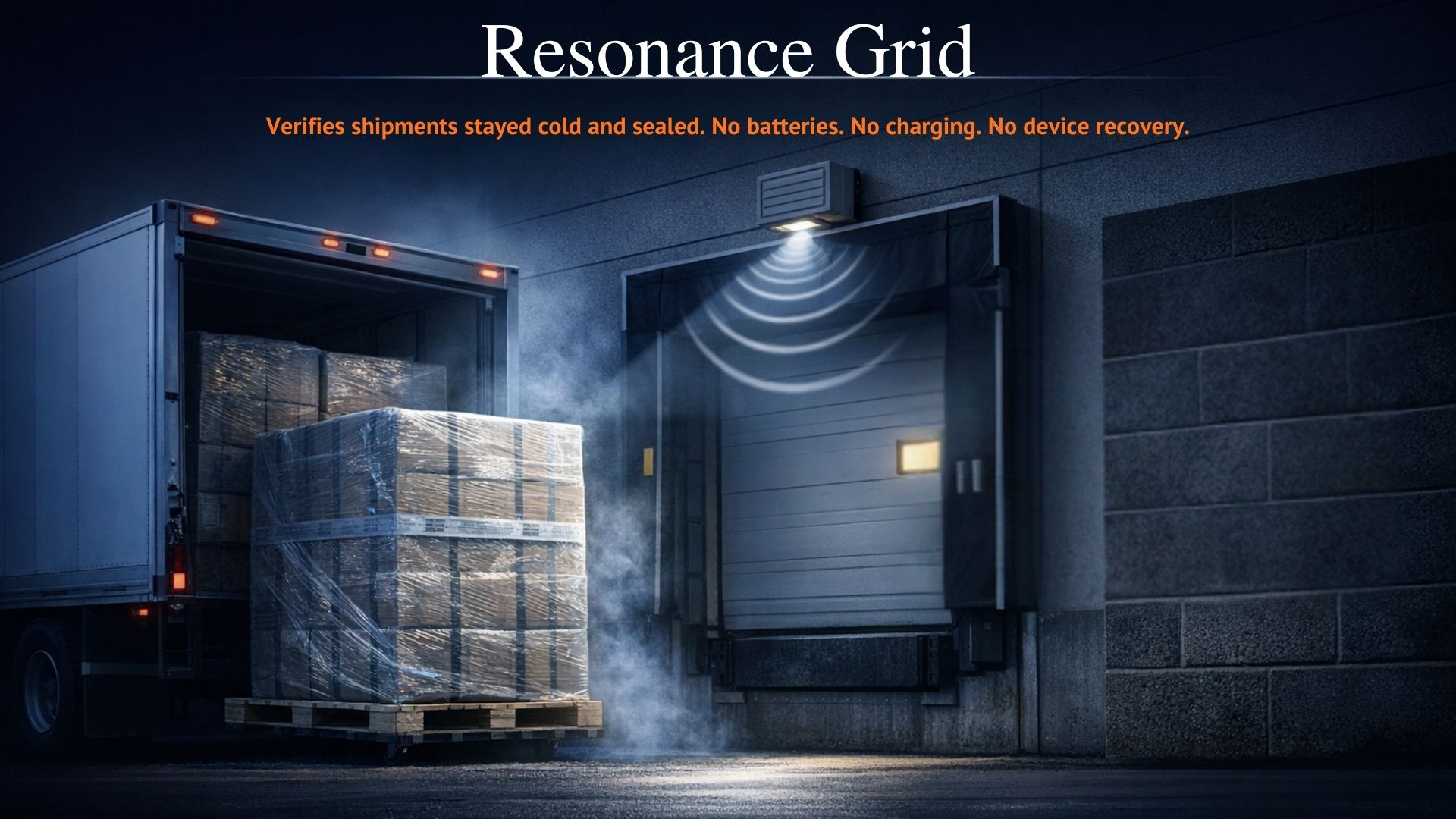
Detect temperature excursions, tampering, and seal breach at every custody transfer point. No batteries. No retrieval. No failure.
The Model Problem.
Whether you are moving food through a distribution network, regulated goods across a supply chain, or medical materiel through a defense logistics node, every verification solution in use today requires the same thing: a battery, a retrieval, or a person. None produce a governed pass/fail at the moment custody changes hands.
Different industries. Different buyers.
The Same Broken Model.
Commercial & Regulated Logistics
- The US cold chain moves $94 billion in temperature-sensitive goods every year.
- Seven to nine percent of those shipments experience a temperature excursion.
- Problems are discovered at receiving, after the load is already a loss or a dispute.
Defense & Government
- DoD OIG found 28,594 items omitted from accountability records at a single forward logistics element.
- Different industry. Different buyer.
- The same monitor-retrieve-process model. The same failure mode.
Battery-Based Logging (Current Standard)
Rehzon Grid
Six Layers.
One Platform.
Rehzon Grid stacks six capabilities that today exist only in isolation into one unified verification architecture. No current solution delivers all six together.
Embedded
Moves
Interrogation
Issued
Provenance
Package-Integrated Sensing
Simultaneously detects temperature excursion, tamper, spoilage, and fill-state from a single sensor element embedded in packaging. No batteries. No wires. External to container. Mass-producible.
Battery-Free Thermal Verification
Verifies thermal exposure wirelessly via dielectric change measurement. Damage tolerant. Flexible form factor. Tunable temperature range. No electrical connections required.
Material Anomaly Detection
Detects surface and subsurface anomalies, including hidden damage, moisture intrusion, and material-state changes invisible to surface inspection or standard logging.
Passive Checkpoint Identity
Long-range and wide-coverage passive identity at custody transfer points without GPS and without tag power. Both range and coverage simultaneously, which conventional RFID cannot deliver.
Anomaly-Aware AI
Learns nominal behavior from archived sensor data and flags real-time deviation without requiring examples of failure. Active alerting before compromised materiel reaches the next checkpoint.
Governed Provenance
Every scan, every pass/fail, and every anomaly flag flows into a governed record with full lineage and cross-domain relationships for decision-grade planning.
One Platform.
Two Markets.
The same verification architecture that addresses DoD's physical-state accountability gap serves every regulated logistics environment where high-value, temperature-sensitive goods change hands.
Strategic Logistics Assurance
DLA and DoD logistics systems move $50B+ in materiel annually through a network with no battery-free, infrastructure-level physical verification layer at custody transfer points. Rehzon Grid closes that gap.
- DLA pharmaceutical and medical cold-chain
- Forward deployed logistics nodes
- Strategic inventory assurance
- Theater supply accountability
- DHA medical materiel verification
Regulated Logistics Verification
Battery-based loggers add cost, retrieval burden, and post-event discovery to every regulated shipment across food, biotech, chemical, and industrial sectors. Rehzon Grid scales to full pallet density with no per-shipment hardware cost.
- Food and grocery distribution
- 3PL logistics providers
- Cold storage operators
- Biotech and clinical trial logistics
- Chemical and industrial regulated goods
Controlled Validation.
Rehzon Grid is preparing controlled validation pilots with regulated logistics and defense partners. The objective is to validate sensing accuracy, checkpoint reliability, and custody workflow integration under real operating conditions.
Detection Sensitivity
Validate temperature excursion detection, tamper indication, and moisture detection against defined thresholds under controlled exposure conditions.
Scan Reliability
Measure interrogation success rates at custody transfer points across realistic dock and warehouse environments.
Operational Friction
Quantify time required for checkpoint verification and measure integration ease into existing compliance workflows.
Provenance Record Quality
Validate that custody events produce complete, governed, audit-ready data records with full lineage traceable across each node.
Pilot Evaluation Metrics:
- Detection accuracy under defined exposure conditions
- Scan reliability at custody transfer points
- False positive and false negative rates
- Time required for checkpoint verification
- Compliance and custody workflow integration
- Governed provenance record completeness
Get Involved.
Whether you are a logistics operator, a defense partner, an implementation partner, or an investor, we want to hear from you.
Implementation Partners.
Both Welcome.